Posts

Week of June 10th

Image
 Our last unit in Math returns to Geometry and Transformations. In this unit, we are performing, identifying, and describing translations on a grind, including simple maps. We are also learning to identify reflections and rotations of simple shapes and connect reflections to symmetry. As part of this unit, I thought it would be a great connection to the art of printmaking.  Printmaking is one of the fine arts (including painting, drawing, collage, and sculpture) that involves making a “master plate,” which you can then use to make multiple images printed in reverse. There are so many ways to print; it’s almost endless! Potatoes and veggie printing, linoleum printing, bubble wrap printing,  yarn printing… basically any object can be used to print with. Styrofoam printing is really one of the simplest ways to teach printmaking for kids. The students did a great job creating a design and then transferring it to a Styrofoam plate. They enjoyed the process, and I know I would ...

Week of June 26th

Image
 This will be my last entry for the grade 3 class of 2022/2023! We have had an amazing June filled with great explorations and time outside. I would first like to say a big thank you to the parents who made our National Indigenous People's Day such a wonderful success. The students had a fantastic time exploring Prince's Island Park and participating in many hands-on learning tasks outside in nature. The goslings and ducks did not disappoint!  In class, we finished off the year by writing a letter to our new grade 3 students. Sharing with them all of the wonderful things they have to look forward to as they begin a new year in room 8. After brainstorming our entire year of events and activities, we found it hard to believe all of the learning and adventures we could participate in. We also had fun this month revisiting our poetry unit and creating Limmercks and more Haiku poems. Our math year ended, reviewing past lessons and exploring translations.  In the first part of ...

Week of June 5th

Image
As part of our community walks we have started to discover the joins of nature journalling.   In doing so, we are continuing to discover how journaling in nature helps support our ability to pay attention to detail, boosts our creativity and inspires us to observe a location we have become familiar with.   This week and last, we revisited our unit on Data analysis. We spent time reviewing how to read and interpret information presented in the form of pictographs and bar graphs. We learned how to analyze the data presented in the graphs to solve one- and two-step word problems. We will also explore scales and scaled pictographs, and bar graphs. We discovered how to use multiplication and division skills to find the numbers represented on these scaled graphs. As a class, we collected data about a topic that interested us and created our bar graphs. In the following week, we will compare all three types of graphs: pictographs, bar graphs, and line plots ( dot plots) and solv...

Week of May 22nd

Image
This week we started your Rocks and Minerals unit in Science. In this unit we will be learning about materials found on Earth’s surface—rocks, minerals and soil. We will be examining sample rocks, and discovering the similarities and differences using simple tests and tools. As we discover more about rocks we will learn that each kind of rock has a set of characteristics and that these characteristics can be used in classifying and identifying them. Our unit will also include the study of soil, as we learn that the materials in soil include include rock fragments and remains of living things. As we continue to enjoy the outdoors on our community walk, we focused our attention this week on the beautiful cityscape that we get from the top of Scottman's Hill. We used this as an opportunity to review our knowledge of 2 and 3 dimensional shapes. Further along on our walk, we were also thrilled to discover another pair of mating osprey and their nest at the top of a new structure.  ...

Week of May 8th

Image
 This week in literacy, we continued with our poetry unit and created a Diamanté poem for Mother's Day. We also continued to develop our research skills by choosing and representing an invertebrate of our choice. We also looked closely at the rules required to learn how to add "ed" and "ing" endings correctly. We discovered that when adding "ed," there are three rules to follow. Rule 1: If two consonants follow a vowel, just add -ed. Rule 2: If you have a v-c-e pattern, drop the silent e and add -ed. Rule 3: If a vowel is followed by one consonant, double the last letter and add -ed. When adding "ing" we learned that if we have a short vowel sound with one consonant, we double the consonant and add "-ing" as in putting. If we have a short vowel sound with two consonants we just add "ing" as in jumping. Finally, if a word ends in "e" we drop the "e" and then add the "ing as in joking.  In math, we b...

Week of May 1st

Image
In class this week, we began to understand the art of persuasion and the art of persuasive writing. We looked at several stories that helped us see characters trying to persuade someone for something important to them. "I Wanna Iguana" by Karen Kaufman Orloff and David Catrow is a great example. This story is a series of letters between a mother and son. In his letters, the son tries to convince his mom to let him get a pet iguana. In her letters, she makes counter-arguments against his reasons for getting an iguana. Some arguments are good, and some aren't as good. But, in the end, Alex's reasons prevail, and he gets his iguana. We discussed what the word "persuade" means, and as a class, we brainstormed topics that we could write a persuasive argument. Here are some examples:  -Being allowed to get a puppy - Extending our recess time -Staying up 15 minutes later in the evening -Getting a new set of golf clubs -Having a swimming pool built in your backyar...

Week of April 24th

Image
 This week in Math, we have started our money unit. In this unit we will learn how to count money, including coins and bills. We will learn the relationships among coins, including the penny. Although the penny is no longer used in Canada, the value of the penny as one cent is still important as the base value of all the other coins. We will count money amounts involving coins starting with the larger value, and we will learn to represent money amounts using the least number of coins. Once we have familiarized ourselves with coins we will learn how to make change by counting to the nearest multiple of ten and then counting up to the nearest dollar.  Our money unit has a great connection to our Social Studies topic regarding the difference between needs and wants as well discussing and identifying the difference between goods and services. We learned that a good is something you buy and consume. Goods are things that you can keep, eat or use. A service is something that someone...

Week of April 17th

Image
This week the students continued to work diligently on their Life Cycle animation projects. The students have been doing an excellent job creating their short films to represent what they have learned about their animals' habitats, adaptations and life cycles. They are now practicing reading their script to coincide with their movies. We hope to have them all completed by the end of the week and posted in google classroom for you to watch. Stay tuned.  We have been participating in Literacy Circle groups for the last month in Literacy. This has been a lovely time to enjoy being in small groups and supporting each other as they read a chapter book. Through structured discussion, Literacy Circles guide students to gain a deeper understanding of what they have read through structured discussion and written and visual responses. Each day the members of the group rotate through specific jobs. I have included the groups' instructions to better understand these jobs and the tasks invo...

Week of April 11th

Image
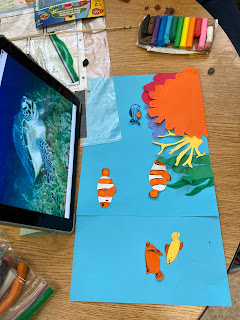
How lovely to enjoy being outdoors for our field trip to the Calgary Zoo this week! I want to take a moment to thank our parent volunteers who helped make our trip possible. We had a wonderful time applying the learning we have been undertaking in class regarding animal adaptation. While at the zoo, our learning task was as follows:  In class, the students have been busy researching a specific animal's life cycle, its habitat and the adaptations the animal requires to survive. In addition, we have connected this project to include literacy as we have been busy preparing a script and practicing reading it out loud to begin creating a claymation stop motion video.  In Math this week, we have completed our multiplication and division unit. In our division unit, the students learned about division as a method of sharing. We learned how to model two ways of sharing: when the number of sets is known and when the number of items in each set is known. We also learned how to divide by ...

Week of March 13th

Image
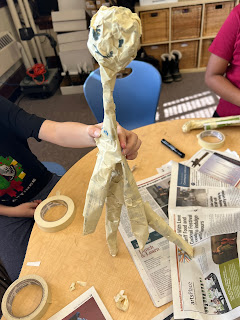
This week in literacy, we focused on creating a story using wordless picture books. This has been another great way to help us learn how to create rich stories. Using the books, we could tell a story orally and then create a modified version. We took the time to look closely at the illustrations so that we could find the words to describe what the character and setting were showing us. The stories were very imaginative, and we quickly learned if you can tell a story, you can write one!  While editing our writing, we have learned how to use a dictionary to help find the spelling of new common words. We have also been learning about the homonyms their, there, and they're, as well as to, too and two. To enhance our work, we have also been paying close attention to synonyms and using them as much as possible to avoid word repetition.  This week our puppetry residency came to an end. The students had a fantastic time learning how to create a variety of puppets and being exposed to ...

Week of March 6th

Image
This week it was lovely to have the opportunity to meet with so many of you during parent teacher conferences. Thank you for making the time and effort to join me online or to come into the school in person. We have so much to celebrate! Several parents indicated how helpful it is for me to share the strategies your child is introduced to when learning new math concepts, so this week in our blog I will share the strategies we have begun to explore to learn division. Our focus this week was to learn how to skip count to divide. We discovered how to skip count on a number line, skip count using our fingers and that we can divide by sharing the total number of items and the number of times in each set.  To use a number line we considered, what number is being divided? (20) How can you tell from the picture? (20 is where the arrows end) What number are we dividing by?(4) How can you tell? (4 is the size of the jump) So, what is the answer to 20  ÷  4? (5) How can you tell fro...

Week of Feb. 27th

Image
 This week in literacy, we continued to look closely at the skills required to write a biography. As a class, we all researched and collaborated to write a group biography about David Attenborough and Keith Haring. Next week the students will choose their individual of interest to research and write a biography. After reading several biographies, we determined what is required in each paragraph and how to link our sentences together so that the information flows nicely with good transition words. We also used this opportunity to discuss how to edit our work and avoid repeating the name of an individual over and over again. We have also been intentionally learning how to decipher and use the synonyms for their, there, and they're, as well as to and two. Below is our student class collaboration.  Writing a Biography David Attenborough Paragraph 1 Name/Gender When they were born Where they were born/where are they now Childhood  - siblings -important events -hobbies -what ma...

Week of Feb. 21st

Image
This week in Literacy, we worked hard to complete our wonderful stories based on the movie Snack Attack. We have been learning and appreciating the importance of the editing process and understanding that editing our work will often take as much time as it does to write our stories. We have also been learning to appreciate the feedback we can provide our peers by pairing up and doing a peer edit. Learning how to reflect on our work and appreciate our strengths and areas of growth will be essential as we develop our writing skills. We also spent this week learning how to write a biography by determining what is important to include in a biography and placing the information into three paragraphs.  In mathematics, we will begin to introduce division. To conclude our Multiplication unit, we had fun playing several games that helped solidify our basic facts up to 9x9. I have included the games on our google classroom and a great trick to support our ability to memorize our nine times t...

Week of Feb.13th

Image
  In math this week, the students spent time gaining more confidence with multiplication facts and applications. We also learned how to apply our multiplication skills when searching for a perimeter of a shape. We were reminded that the perimeter is the distance around a shape, and the length is measured in units such as meters or centimetres. Therefore, we can use multiplication instead of repeated addition when the perimeter sides are the same. In geometry, we reviewed the names of 2-D shapes and created images. We used these images to locate and identify the number of 90-degree angles our pictures contained. In literacy, we had lots of fun using the short wordless animation film "Snack Attack" to create our short stories. The video tells the story of an old lady and her intention to eat some snacks (cookies). The short movie touch on a sequence of quite compelling themes: Understanding elderly people. Judging someone based on their appearance. Looking and stereotyping them...

Week of Feb. 6th

Image
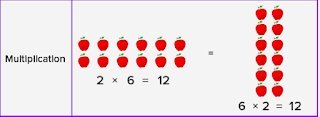
This week in literacy we explored the importance of having a strong beginning of a story to capture our audiences attention. We explored a variety of fictional books and record which story beginning we liked. We discovered that the beginning of a story sets the tone for everything that will happen next. An opener is like an appetizer, offering a reader a glimpse into what is to come. several of the strategies we explore were to: begin with an action or dialogue, ask a question, describe the setting, provide some background information or have the main character introduce him or herself.  In Math, we have learned how to write a multiplication sentence and model multiplication as equal groups. In doing so we have also built on our understanding the connection between multiplication and repeated addition. This week the students learned how to model multiplication using arrays. Through the use of arrays we were also able to explain what the commutative property of multiplication is i.e...